Metering
CT Metering: How Large Installations Are Metered
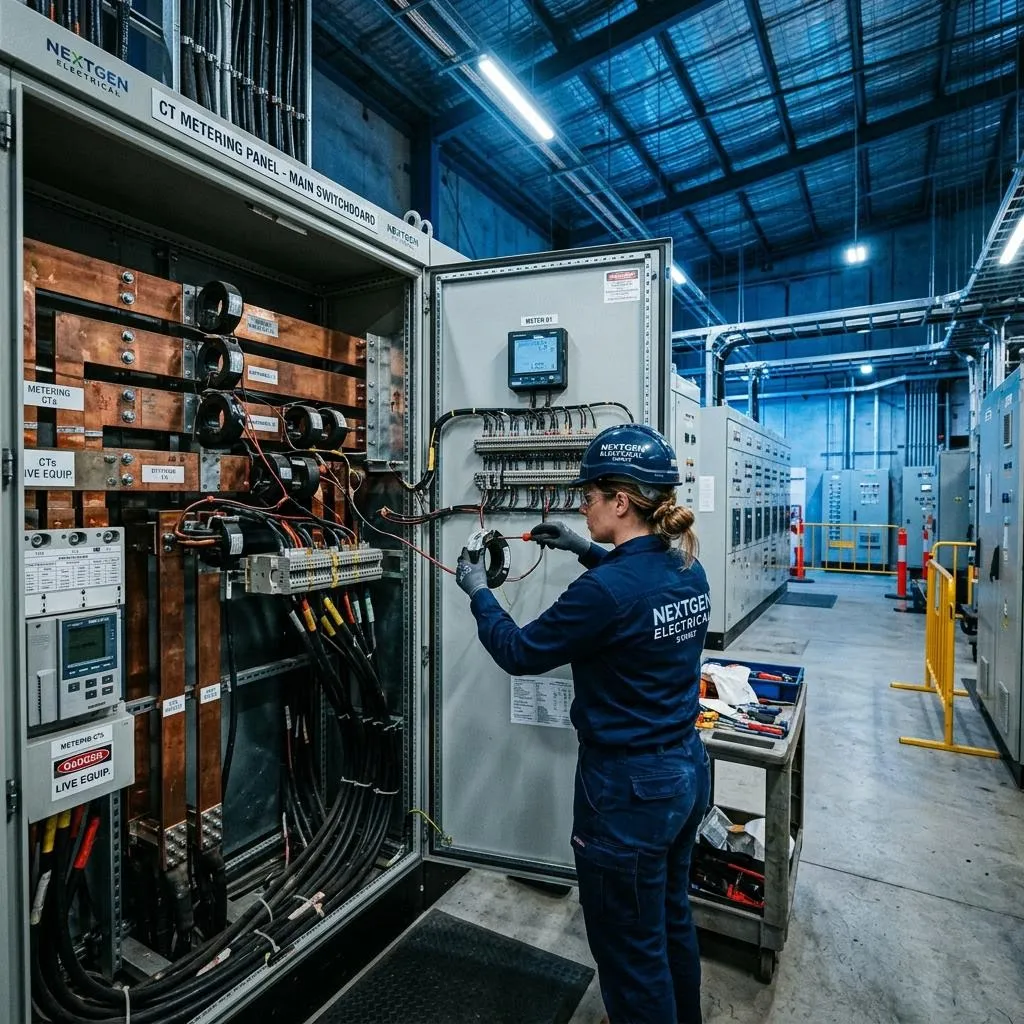
CT metering — current transformer metering — is the method used to measure electricity in installations whose demand is too high to be metered directly. Instead of passing the full supply current through the meter, current transformers (CTs) are fitted around the main conductors to produce a small, proportional current that the meter can safely measure. It is the standard arrangement for larger commercial premises, industrial sites, and big multi-unit developments, and installing it is Level 2 ASP work coordinated with the metering provider — closely related to our CT metering and metering panel services.
Why Direct Metering Isn't Always Possible
A standard domestic or small commercial meter is a direct-connected meter: the full supply current passes through it, and it measures consumption directly. This works well up to the current rating of the meter and its associated wiring — typically the sort of loads found in homes and small businesses.
Once an installation's maximum demand exceeds what a direct-connected meter can safely carry, direct metering is no longer practical or safe. Running hundreds of amps through a domestic-style meter is neither feasible nor compliant, so a different approach is needed. That approach is CT metering.
The threshold at which CT metering becomes necessary is defined by the supply size and the network's metering requirements, and it is confirmed as part of designing the metering for a large three-phase commercial connection.
How Current Transformers Work
A current transformer is a ring or split-core device fitted around each phase conductor. It produces a secondary current that is an accurate, scaled-down proportion of the current flowing in the main conductor — for example, a CT with a ratio of 200:5 produces 5 amps at its output when 200 amps flow through the main conductor.
The meter measures this small secondary current and multiplies it by the CT ratio to calculate the actual consumption. This lets a standard-sized meter accurately measure very large loads without the full current ever passing through it, keeping the metering equipment safe and appropriately sized.
CT metering installations must be wired precisely — the CT ratio, the polarity and the connections all have to be correct, because an error results in inaccurate billing. This is one reason CT metering is specialised work rather than a routine meter swap. A reversed CT or an incorrectly recorded ratio can under-record or over-record consumption for the life of the installation, so accuracy at the point of installation is critical.
Where CT Metering Is Required
CT metering is typical for larger commercial and industrial premises — warehouses, factories, large retail and hospitality venues — and for big multi-unit residential and mixed-use developments where the total demand is high. Anywhere the maximum demand exceeds the limit for direct metering, CTs are the answer.
It also appears in embedded network and multi-tenant metering arrangements, where accurate measurement of large aggregate loads is essential. In these settings the metering design, the metering panel and the CT installation all need to be planned together.
Under the Power of Choice framework the meter itself is arranged through the retailer's metering provider, but the metering panel, the CT installation and the associated Level 2 work — including any network disconnection — are carried out by a Level 2 ASP.
Planning and Installing CT Metering
A CT metering installation begins with the metering design: confirming the supply size, selecting the correct CT ratio for the expected demand, and designing the metering panel to house the CTs, meter and associated equipment safely and accessibly. This has to align with both the network's metering requirements and AS/NZS 3000.
The Level 2 ASP then installs the metering panel and CTs, wires the metering circuits, and coordinates with the metering provider for the meter itself and with the network for any disconnection required to complete the work safely. Accuracy in the CT ratio and wiring is critical, so the installation is carefully verified before energisation.
Sydney Power Group carries out CT metering and metering panel work for commercial and high-load installations across all three NSW network areas, managing the design, the Level 2 installation and the coordination with the metering provider as one project.
Maintaining and Testing CT Metering
Because CT metering underpins the billing for large premises, its accuracy has real financial consequences over time — a small error scaled up by a large CT ratio and a high load can add up to a significant billing discrepancy. This is why CT metering installations are set up carefully and the CT ratio, polarity and wiring are verified before the meter is put into service.
Over the life of a commercial installation, the metering may need attention when the building's load changes. If a site expands and its demand grows well beyond the original CT ratio, the CTs may no longer be sized appropriately and the metering arrangement needs review; conversely, a metering panel that has aged or been damaged may require refurbishment. Any of this work is Level 2 ASP work coordinated with the retailer's metering provider.
For building owners and managers, the practical point is that CT metering is not a set-and-forget component. A change of tenancy with a very different load profile, a fit-out that adds substantial plant, or an expansion of the premises are all triggers to have the metering reviewed so it stays accurate and compliant. We can assess an existing CT metering installation and advise whether the arrangement still suits the load.
Frequently Asked Questions
What is CT metering?+
CT (current transformer) metering measures electricity in installations whose demand is too high to meter directly. Current transformers around the main conductors produce a small, proportional current that the meter measures, allowing a standard-sized meter to accurately measure very large loads.
How does a current transformer work?+
A CT is fitted around a phase conductor and produces a secondary current that is a scaled-down proportion of the main current — for example, a 200:5 CT outputs 5A when 200A flows through the conductor. The meter multiplies this by the CT ratio to calculate actual consumption.
When is CT metering required instead of a normal meter?+
When an installation's maximum demand exceeds what a direct-connected meter can safely carry. This is typical for larger commercial, industrial and big multi-unit developments, and the threshold is defined by the supply size and network metering requirements.
Does a Level 2 ASP install CT metering?+
The meter is arranged through the retailer's metering provider, but the metering panel, CT installation, metering circuits and any network disconnection are Level 2 ASP work. The design and installation must align with the network's requirements and AS/NZS 3000.
Why does the CT ratio matter?+
The meter relies on the CT ratio to scale its measurement up to the actual consumption. If the ratio, polarity or wiring is incorrect, billing will be inaccurate — which is why CT metering is specialised work requiring precise installation and verification.
Is CT metering used in apartment developments?+
It can be, particularly in large multi-unit and mixed-use developments and in embedded network arrangements where high aggregate loads must be measured accurately. The metering design, panel and CT installation are planned together.
Can you retrofit CT metering to an existing building?+
Yes. Where a building's demand grows beyond direct metering — for example after a load increase or expansion — a Level 2 ASP can design and install a CT metering arrangement and coordinate the change with the metering provider and network.
Call us now for a no-obligation quote. Emergency response available 24/7.
0466 125 125Get a Free QuoteWhat Sydney Says About Us
Don't take our word for it — read genuine reviews from real customers on our Google profile, or leave one after your job is done.
Read Our Google ReviewsMore From The Knowledge Centre
Need a Level 2 ASP Electrician?
Free assessment on any network electrical job. Emergency? We answer around the clock.